
Introduction
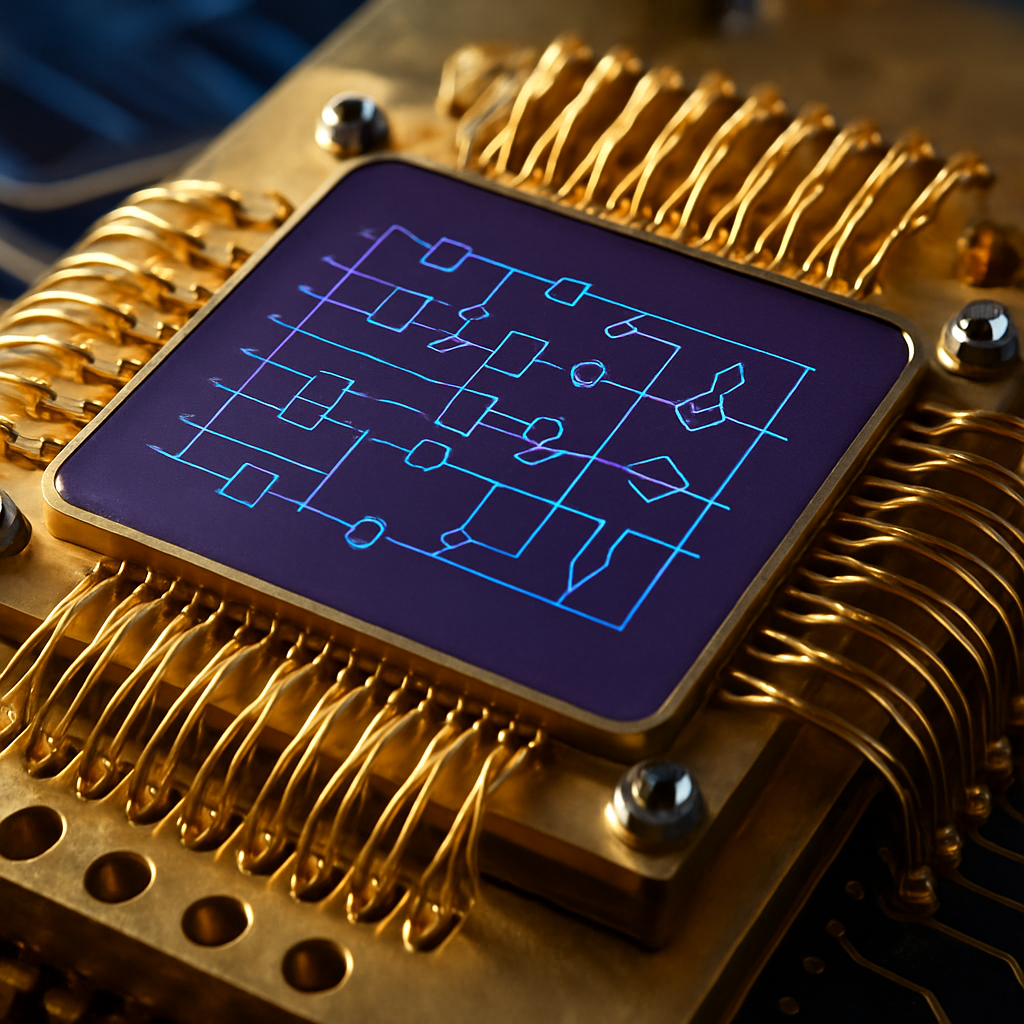
Quantum computing isn't just the next step in computing—it's a technological leap that could transform science, medicine, cybersecurity, and beyond. Unlike classical computers that use bits, quantum computers use quantum bits (qubits), unlocking unprecedented computational power. Backed by quantum mechanics, this technology is not theoretical fantasy; it’s already showing results in laboratories and early-stage applications.
What Is Quantum Computing?
Traditional computers process data using bits that represent either 0 or 1. Quantum computers use qubits, which can exist in a superposition of states—meaning they can represent both 0 and 1 simultaneously. This is enabled by the laws of quantum mechanics, including entanglement and interference.
In quantum superposition, a qubit can hold a combination of multiple states until measured. When multiple qubits become entangled, the state of one qubit is dependent on another, no matter the distance. These principles exponentially increase the potential computational power.
Scientific Basis
The foundation of quantum computing lies in quantum mechanics, specifically the Schrödinger equation for describing quantum states and unitary operations for computing transformations. Unlike classical computing, where logic gates are based on Boolean algebra, quantum logic uses linear algebra and complex vector spaces.
Why Does It Matter?Quantum computers could solve problems too complex for classical computers. For example, simulating molecules for drug discovery requires modeling electron interactions that grow exponentially with atom count—a task that overwhelms even supercomputers.
Here are key domains quantum computing is set to impact:
Cryptography: Quantum computers can break RSA encryption using Shor’s Algorithm, which factors large numbers exponentially faster than classical methods.
Optimization: Logistics, finance, and supply chain models can be solved faster with quantum algorithms like Quantum Approximate Optimization Algorithm (QAOA).
Drug Discovery: By simulating quantum interactions in molecules, quantum computers can predict drug behavior at the atomic level.
Artificial Intelligence: Quantum machine learning can process vast datasets with parallelism that accelerates training and inference.
Quantum Supremacy: A Milestone
In 2019, Google claimed to achieve quantum supremacy—a term for when a quantum computer solves a problem beyond classical capabilities. Their 53-qubit processor, Sycamore, performed a computation in 200 seconds that would take a supercomputer 10,000 years.
While this specific task was not practically useful, it marked a key turning point: quantum hardware is no longer science fiction. It's a functioning reality.
The Hardware Race
Quantum computers are not just faster classical machines—they require entirely different hardware. There are several approaches:
Superconducting Qubits (used by IBM, Google): Operate at near absolute-zero temperatures using Josephson junctions.
Trapped Ions (IonQ, Honeywell): Use lasers to manipulate ions suspended in electromagnetic fields.
Photonic Qubits (Xanadu): Use particles of light for room-temperature quantum computing.
Topological Qubits (Microsoft): Still theoretical but promise improved stability through exotic quantum states.
Each approach has trade-offs in coherence time, error rates, and scalability.
Challenges Ahead
Quantum computing is not yet ready for general-purpose use. Some of the biggest challenges include:
Error Correction: Qubits are sensitive to noise and environmental interference. Quantum error correction requires hundreds or thousands of physical qubits to produce a single logical qubit.
Decoherence: Qubits lose their quantum state quickly, typically within microseconds, limiting computation time.
Scalability: Building systems with millions of stable qubits is still a long-term goal.
Researchers are developing fault-tolerant architectures and quantum error correction codes like the surface code to address these issues.
Quantum Algorithms
Beyond Shor’s and Grover’s algorithms, new quantum algorithms are being developed for finance, AI, and chemistry. Here are a few:
Harrow-Hassidim-Lloyd (HHL) Algorithm: Solves linear systems exponentially faster than classical counterparts.
Variational Quantum Eigensolver (VQE): Finds the lowest energy states of molecules, aiding material science and chemistry.
Quantum Support Vector Machine (QSVM): Enhances classification tasks in machine learning.
These algorithms are optimized for Noisy Intermediate-Scale Quantum (NISQ) devices—the current generation of quantum processors.
Real-World Applications in Development
Drug Development: Companies like Roche and Biogen are partnering with quantum startups to simulate protein folding and molecular binding.
Financial Modeling: Banks are exploring quantum algorithms for risk analysis and portfolio optimization.
Climate Modeling: Simulating molecular interactions in the atmosphere can help forecast climate trends more accurately.
Secure Communications: Quantum Key Distribution (QKD) enables unbreakable encryption by using the principles of quantum mechanics.
Future Outlook
Quantum computing is not expected to replace classical computing, but to work alongside it in hybrid systems. Companies like IBM and Google are pursuing Quantum-as-a-Service (QaaS) cloud platforms, allowing developers to run quantum algorithms on real hardware through the cloud.
According to projections, we may reach fault-tolerant quantum computing within the next 10–15 years. By then, industries ranging from logistics to healthcare may be running quantum-accelerated workflows.
ConclusionQuantum computing stands at the intersection of physics, computer science, and engineering. Its potential is massive—but so are its challenges. With continued research and investment, it could revolutionize fields where classical computers fall short.
For now, we're witnessing the birth of a technology that could redefine the limits of what's computable.