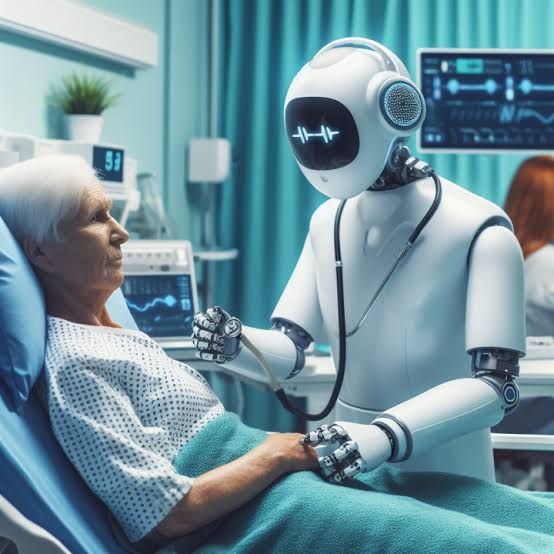

Artificial Intelligence (AI) is rapidly evolving from a niche technology to an integral partner in healthcare, often described as the "stethoscope of the 21st century". While it is unlikely to completely replace human physicians in the near future, AI is set to fundamentally change the role of doctors by handling data-intensive, routine tasks, allowing human clinicians to focus on complex decision-making and compassionate care.
Current Role: AI as an Assistant
AI is already widely used to assist doctors, with two out of three physicians reporting its use in practice.
AI is already widely used to assist doctors, with two out of three physicians reporting its use in practice.
- Administrative Efficiency: AI automates tedious documentation, such as taking notes during visits, ordering tests, and creating discharge summaries. This reduces burnout by easing the administrative burden.
- Diagnostic Support: AI tools in radiology (e.g., in MRIs and CT scans) can identify abnormalities like fractures or tumors, often with accuracy comparable to, or exceeding, human experts.
- Predictive Analytics: AI can monitor patients via wearables and alert doctors to deterioration in real-time, such as predicting sepsis or arrhythmias before they become critical.
The Future: Towards "Dr. AI"
In the coming years, AI will evolve from a passive tool into an active, intelligent partner.
In the coming years, AI will evolve from a passive tool into an active, intelligent partner.
- Personalized Medicine: AI will analyze vast amounts of genomic, clinical, and lifestyle data to tailor treatment plans for individual patients.
- Advanced Diagnostics: AI will provide more comprehensive, three-dimensional views of organs (e.g., 360-degree heart monitoring) rather than just interpreting 2D images.
- Ubiquitous Healthcare: AI-powered chatbots and virtual assistants, like those currently in clinical trials (e.g., Vox Cura), will provide on-demand, accurate medical advice and triage, particularly in underserved, remote areas.
Why Humans Remain Irreplaceable
Despite advancements, human physicians are essential for several reasons:
Despite advancements, human physicians are essential for several reasons:
- Empathy and Communication: AI cannot replicate the emotional support, trust-building, and human connection essential for patient care.
- Complex Judgment: Medicine often involves ambiguous, nuanced cases that require creative problem-solving and ethical reasoning beyond the capability of algorithms.
- Physical Examination: In many fields, particularly in acute care, a direct physical examination is necessary.
Challenges and Ethical Considerations
- "Hallucinations" and Accuracy: Generative AI can sometimes generate incorrect information ("hallucinate"), which in a medical context can be dangerous.
- Data Bias and Privacy: AI models can perpetuate existing biases in care if trained on non-representative data, and the handling of sensitive patient data requires high security.
- Liability: Determining who is responsible (the doctor or the AI developer) for errors made by AI-driven decisions remains a complex legal issue.
Conclusion
The future of medicine is not "AI vs. Human," but rather "Human + AI." The most effective healthcare will likely be a hybrid model where AI handles the data, and humans provide the care, resulting in a more efficient, accurate, and personalized experience.
The future of medicine is not "AI vs. Human," but rather "Human + AI." The most effective healthcare will likely be a hybrid model where AI handles the data, and humans provide the care, resulting in a more efficient, accurate, and personalized experience.