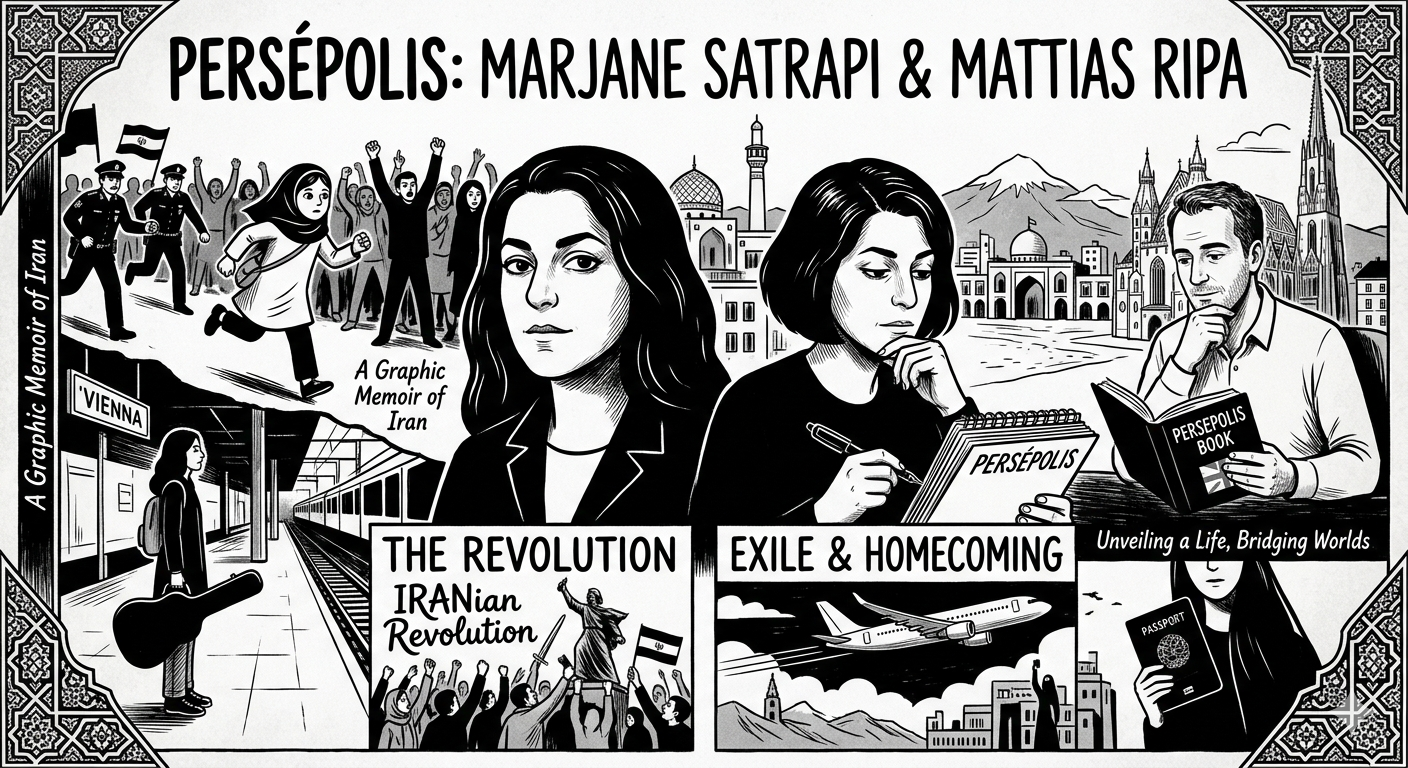

 The Visionary Creator: Marjane Satrapi
Marjane Satrapi was born in Rasht, Iran, in 1969. She grew up in Tehran during a time of massive political upheaval. Her worldview was shaped by her family's Marxist leanings and their opposition to both the Shah and the Islamic regime.
Satrapi moved to Europe as a teenager to escape the oppressive political climate. This experience gave her a unique dual perspective. She uses simple, stark black-and-white ink drawings to make complex political concepts deeply accessible to global readers.
 The Masterpiece: The Persepolis Book
The Persepolis book is a two-part autobiographical graphic novel. It chronicles Satrapi's childhood in Iran during the Islamic Revolution and the devastating Iran-Iraq War.
[Childhood in Tehran] ──> [Islamic Revolution] ──> [Exile to Vienna] ──> [Return to Iran]
Core Themes Explored:
- Loss of Innocence: A young girl forced to wear a veil overnight.
- Class Divide: The contrast between wealthy families and their servants during wartime.
- The Burden of Exile: The intense loneliness and identity crisis of living abroad.
- Regime Oppression: The systemic silencing of art, music, and personal freedom.
 The Crucial Role of Mattias Ripa
While Satrapi provided the raw emotional depth, bringing the story to an English-speaking audience required a delicate touch. Mattias Ripa, her then-husband, played a monumental role in translating the original French text into English.
Translation is more than swapping words. Ripa helped preserve Satrapi’s distinct dry humor, childlike wonder, and sharp political cynicism. This seamless translation allowed the graphic novel to become a staple in high school and university curriculums worldwide.
 Why Persepolis Matters Today
The Persepolis book proves that comic book art can handle serious, historical narratives. It humanizes a country often reduced to negative news headlines. By sharing her vulnerabilities, Satrapi shows that despite cultural differences, the human desire for freedom, love, and self-expression is universal.