
Introduction: What Is Neuromorphic Computing?
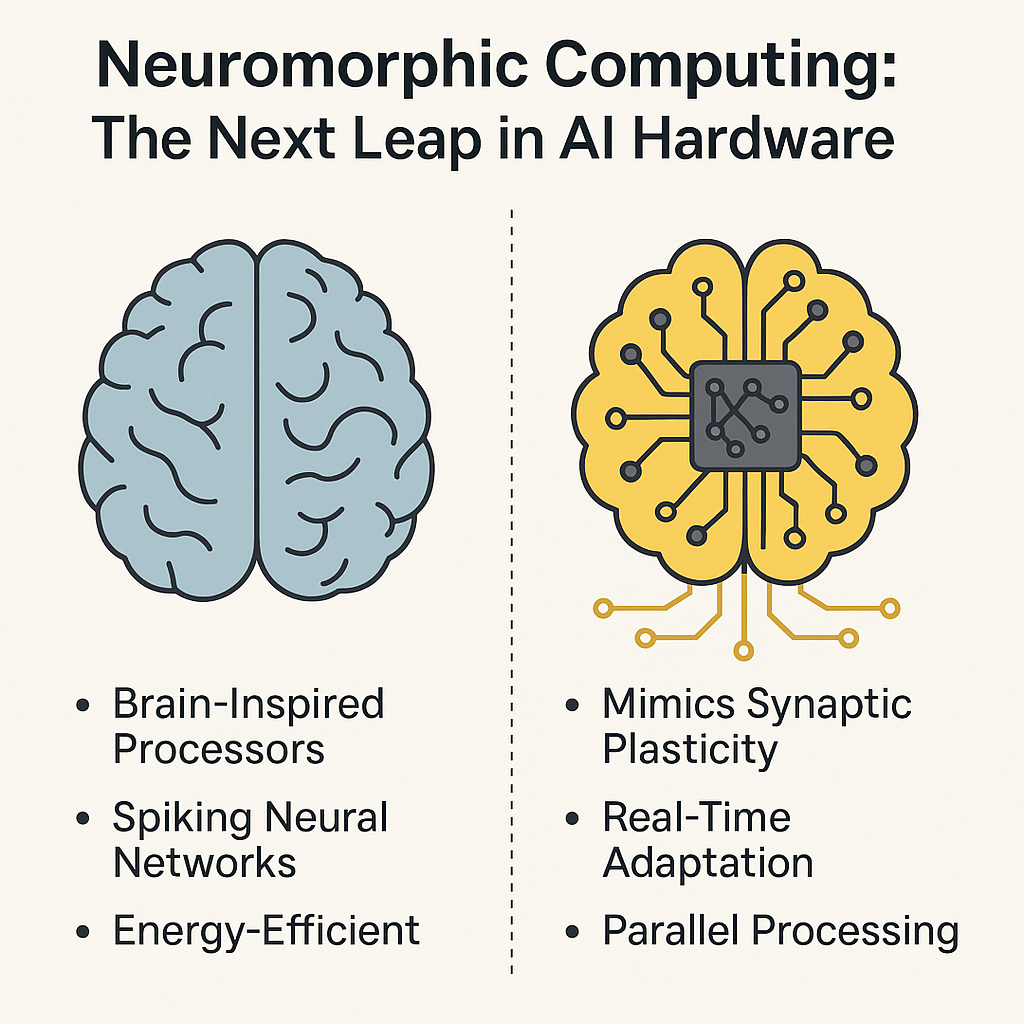
Neuromorphic computing is a groundbreaking approach to hardware design that mimics the structure and function of the human brain. Unlike traditional von Neumann architectures, which separate memory and processing units, neuromorphic systems integrate them in a way that enables faster, more energy-efficient data processing.Inspired by neuroscience, this technology leverages spiking neural networks (SNNs), specialized circuits, and event-driven computation to replicate how biological neurons and synapses communicate. The goal is to overcome the limitations of current AI hardware, especially in real-time learning, adaptability, and energy efficiency.Why Traditional AI Hardware Falls Short
Modern AI runs on GPUs and TPUs—powerful but power-hungry devices. While they excel at parallel processing, they struggle with three core challenges:Energy inefficiency
Latency in real-time applications
Scalability constraints
These limitations hinder the development of edge AI, autonomous robotics, and next-generation smart systems that require low-latency, always-on intelligence.Neuromorphic computing offers a fundamentally different path forward—one where machines can learn, adapt, and interact with their environment using a fraction of the energy.The Science Behind Neuromorphic Hardware Neuromorphic systems are inspired by decades of neuroscience research. Key components include: Spiking Neural Networks (SNNs): Unlike traditional artificial neural networks (ANNs) that rely on continuous signals, SNNs use discrete spikes. A neuron only "fires" when a threshold is reached, which drastically reduces power usage and more closely resembles biological processing. Memristors and Resistive RAM (ReRAM): These components function as artificial synapses. They store and process information simultaneously, allowing for parallel and localized computation. This drastically reduces data movement, which is one of the biggest energy drains in conventional chips.Event-Driven Architecture: Neuromorphic chips process data only when there’s an input event. This asynchronous model is a sharp contrast to clock-driven systems, making them ideal for sensory data like vision and sound.Real-World Applications of Neuromorphic Computing Neuromorphic hardware isn't just theoretical—it’s already being tested in diverse domains:Autonomous Systems: Neuromorphic chips are perfect for drones, robots, and self-driving cars that require fast, local decision-making without cloud reliance.Sensory Processing: Applications like voice recognition, gesture tracking, and image recognition become more efficient when powered by event-driven computation.Edge AI Devices: In IoT ecosystems, neuromorphic processors allow devices to perform complex tasks (like anomaly detection or predictive maintenance) with ultra-low power requirements.Brain-Machine Interfaces: With their brain-inspired architecture, neuromorphic systems are well-suited for decoding neural signals and enabling real-time feedback loops in medical technologies.Major Industry Players and Research Efforts Several tech giants and research institutions are at the forefront of neuromorphic innovation:Intel’s Loihi Intel’s neuromorphic research chip, Loihi, integrates over 130,000 artificial neurons. It has demonstrated success in tasks like robotic arm control and olfactory recognition with unmatched energy efficiency.IBM’s TrueNorth IBM developed TrueNorth, a chip with over a million neurons and 256 million synapses. It operates on a power budget of just 70 milliwatts—orders of magnitude lower than conventional processors.lass="yoast-text-mark" />> Human Brain Project (EU): This billion-euro initiative includes the SpiNNaker and BrainScaleS platforms, both aiming to simulate large-scale neural networks in real time.MIT, Stanford, and Caltech: Leading universities are pushing the theoretical and hardware boundaries of neuromorphic computation, developing new materials, circuits, and algorithms. Challenges in Neuromorphic Computing Despite the potential, neuromorphic computing is not without hurdles:Software Ecosystem: Most current AI frameworks are built for GPUs and TPUs. Developing new tools, compilers, and training methodologies for SNNs is an ongoing challenge.Standardization: There's a lack of standardized benchmarks and metrics for comparing neuromorphic performance across platforms. Manufacturing Complexity: Building memristor-based hardware at scale is still a complex process, both technically and economically.Algorithmic Maturity: While SNNs show promise, they're not yet as mature as deep learning models in terms of accuracy and scalability across all use cases.What the Future Holds The convergence of neuroscience, materials science, and computer engineering is driving rapid progress. Here's what to watch for: Hybrid Systems: Future devices may integrate traditional and neuromorphic processors, using each where it makes sense. Brain-on-Chip Platforms: As fidelity improves, chips that simulate real-time brain activity could revolutionize medical diagnostics, drug testing, and cognitive AI.Autonomous Edge Intelligence: With further miniaturization, neuromorphic chips could become standard in smartphones, wearables, and home appliances—enabling them to think, adapt, and learn locally.AI Sustainability: Given the growing environmental cost of training large AI models, neuromorphic computing offers a greener alternative, aligning with sustainable computing goals.Conclusion: The Next Evolution in AI Hardware Neuromorphic computing represents not just a technological innovation, but a philosophical shift in how machines process information. By embracing brain-like architectures, we unlock new possibilities for energy-efficient, adaptable, and intelligent machines.As AI demands escalate—from real-time robotics to lifelong learning systems—neuromorphic computing is poised to become a critical pillar of future hardware design.